Covid-19 took us all by surprise. Within weeks, a local health issue far from European shores grew to a global crisis of unprecedented proportions. The so-called “Great Lockdown” has brought the global economy to its knees, causing the loss of jobs and businesses while threatening to deplete government budgets and inflate public debt levels1. Forecasts point to the worst economic contraction since the Great Depression: in 2020, the European Commission spring 2020 forecast anticipates a GDP fall of 7.7% in the euro area and 7.4% in the EU2. Far worse outcomes are possible, as the spring forecast’s downside scenarios illustrate. We are in the midst of a deep, uneven and uncertain recession with a long and rocky path to recovery.
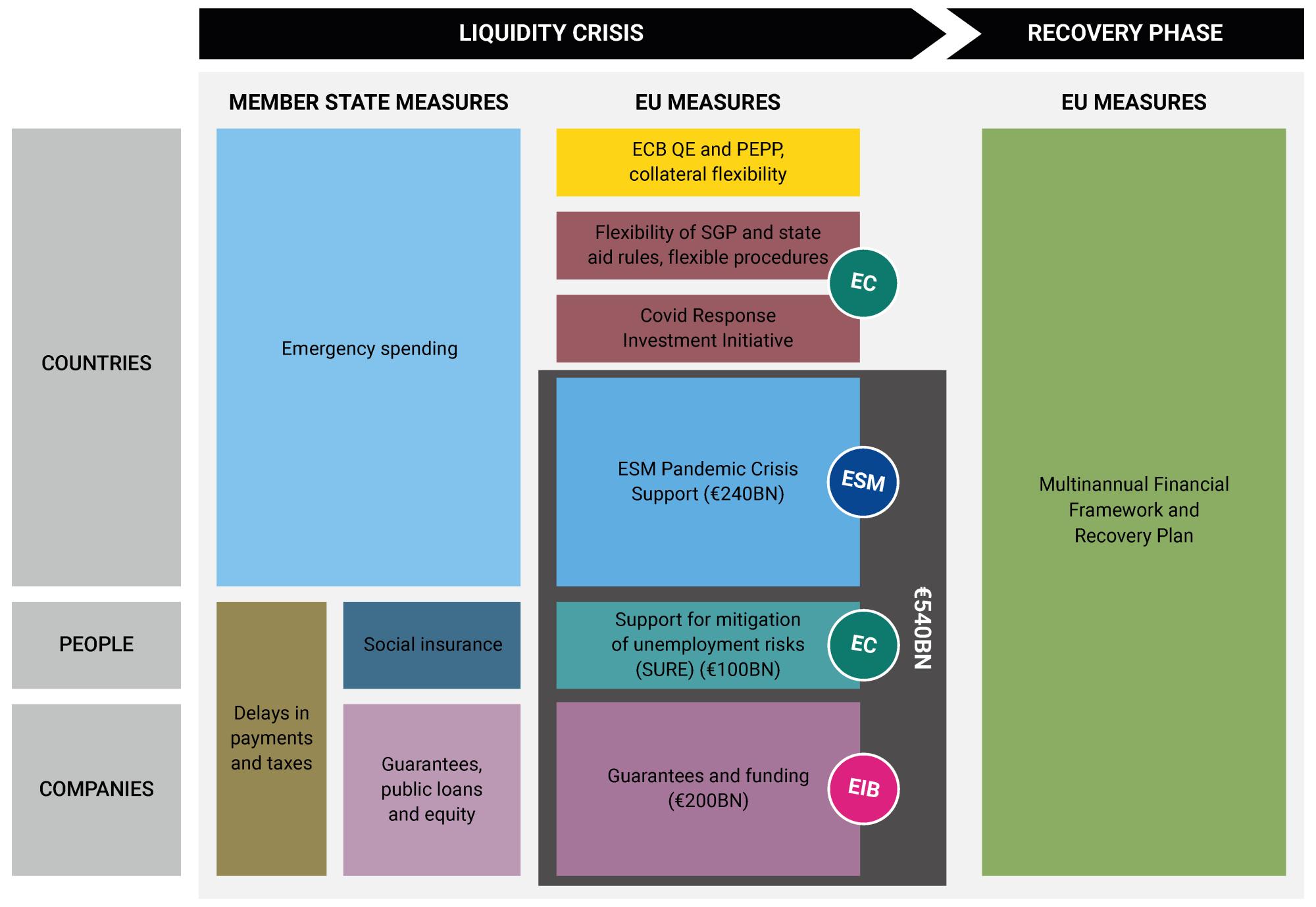
This blog is a joint effort to explain the role of the three institutions — namely the European Commission (EC), the European Investment Bank (EIB) and the European Stability Mechanism (ESM) — and their role in fighting the economic implications of the viral outbreak, and the way ahead.
The severity of this crisis demands swift, coordinated, and extensive policy actions: European citizens need their health and jobs protected by adequate measures. Large firms and small businesses alike must have access to liquidity and preserve cash flows until revenues rise again. Governments also need a helping hand as their swift efforts to protect their citizens and the economy have put an unprecedented strain on their budgets.
The EU and its member states have reacted quickly. Over the past two months, member states have taken discretionary budgetary measures of about 3.2% of GDP and have created liquidity facilities of 22% of GDP. The efforts by member states are supported by actions at the EU level that allow governments to respond more effectively to the needs of their citizens. The European Commission — with support from the Council — has activated the General Escape Clause, which temporarily suspends EU fiscal rules of the Stability and Growth Pact (SGP)3. The Commission has also provided increased flexibility in the implementation of the state aid rules. Finally, rules governing the drawdown of cohesion funds have been relaxed, making available additional funds for member states to fight the crisis.
The European Central Bank (ECB) reacted swiftly by substantially expanding its asset purchase programme, boosting the volume of purchases and widening eligibility with the new €750 billion Pandemic Emergency Purchase Programme (PEPP)4. Further actions to ease the burden on the banking sector and to keep credit flowing have included long-term financing for banks with relaxed collateral requirements, more flexible use of banks’ capital and liquidity buffers, and a boost to guarantee schemes.
All the above measures have been pivotal in preventing a much worse recession in the short term. But they alone are not sufficient to prevent harmful dynamics from playing out across the EU economy in the medium term.